
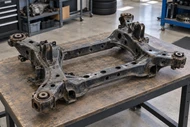
Used Crossmember & Subframe Buying Guide
Posted by Parts Depot on Sep 12th 2026
A used crossmember can be a cost-effective way to replace a damaged structural assembly, but the word “crossmember” is used for several different parts. Identify the assembly, confirm fitment, and assess its condition before comparing prices. A front engine cradle, rear suspension subframe, and transmission crossmember do different jobs and should not be treated as interchangeable search results.
Crossmember versus subframe: what is the difference?
A crossmember is generally a structural member that runs across a vehicle. A subframe is a removable structure that can carry several suspension, steering, or powertrain attachment points. Depending on the vehicle and parts catalog, the same assembly may be described as a suspension member, engine cradle, axle carrier, or crossmember.
| Listing term | What it commonly describes | Confirm before ordering |
|---|---|---|
| Front subframe / engine cradle | A lower assembly associated with front suspension and powertrain mounting | Engine, transmission, steering and mount layout, exact application |
| Rear subframe / rear suspension member | An assembly locating rear suspension attachments; some carry driveline mounts | Drivetrain, suspension layout, differential provisions where applicable |
| Transmission crossmember | A support associated with the transmission mount | Frame/chassis application, transmission, mount position |
| Radiator support / tie bar | A front body or cooling-package support | Exact location, material, attachment method |
| Brace / reinforcement | A smaller stiffening or supporting piece | Which main assembly it attaches to and the service part identity |
Start with the diagnosis, not the seller’s title
Ask the shop to identify the damaged part on a photograph or parts diagram. A clunk, vibration, steering pull, or tire-wear complaint is not a diagnosis of a failed subframe. Worn bushings, ball joints, mounts, tires, and bent suspension arms can produce overlapping symptoms.
When corrosion or a collision is involved, inspect the body or chassis attachment points as well as the removable member. Replacing a bolt-on part does not repair metal loss or displacement in the structure it attaches to. Find out whether the repair is limited to the assembly before paying for freight.
Five checks that make a used crossmember purchase safer
- Identify the exact assembly and installed location, preferably with a marked photograph.
- Confirm the receiving vehicle’s year, engine, transmission, drivetrain, body/chassis details, and VIN.
- Obtain a service-part match, valid supersession, or documented interchange from a reliable lookup.
- Inspect current photographs of the actual part, including upper surfaces and structural mounting areas.
- Confirm included components, delivered cost, return freight responsibilities, and warranty scope in writing.
A VIN is useful input, but the seller still needs to perform the correct lookup. A matching exterior silhouette cannot establish geometry or application. Use the complete used subframe fitment checklist if the original number is missing or the seller offers an alternate number.
Bare assembly or loaded assembly?
A bare assembly usually means the main structure, although the precise inclusion list still needs confirmation. A loaded assembly may include arms, hubs, mounts, steering components, or a differential. There is no universal promise attached to the word “complete.” Ask the seller to list each item that will ship.
A loaded assembly can reduce transfer labor when the attached components are correct and serviceable. It can also bring worn bushings, seized bolts, or an incompatible driveline component. Compare the total installed cost after your shop evaluates which parts it will actually use. Do not pay extra for attached components that will be discarded.
Condition checks that matter more than shiny paint
Request both faces of the member and close-ups of body mounting sleeves, suspension pickups, welded brackets, and threaded locations. Look for cracks, heavy flaking, perforation, buckling, elongated holes, and undocumented welded repairs. Paint can improve appearance without demonstrating the condition underneath.
Ask about missing brackets, cut fasteners, and seized adjustment bolts. A sound frame with troublesome attached hardware may still be usable, but the labor quote should reflect that. The subframe rust inspection guide explains why surface oxidation and structural metal loss require different decisions.
Vehicle-specific buying and replacement guides
Choose the guide for the vehicle and assembly you are investigating. These are buying topics, not a claim that every year or trim within each heading uses one interchangeable part.
- 2006–2009 Toyota RAV4 rear subframe
- 2005–2015 Nissan Armada rear subframe
- 2009–2013 Mazda 6 rear subframe
- 2011–2013 Infiniti QX56 rear subframe
- 2010–2012 Ford Fusion rear subframe
- 2010–2012 Hyundai Santa Fe AWD rear subframe
- 2012 Nissan Pathfinder 4.0L RWD rear subframe
- 2013–2020 Nissan Pathfinder AWD rear subframe
- 2017–2024 Chevrolet Camaro ZL1 rear subframe
- 2009–2010 Nissan Murano AWD rear subframe
What does replacement involve?
The shop obtains the procedure for the exact vehicle, supports the vehicle and any affected powertrain or driveline loads, disconnects the required components, and lowers the member under controlled support. It compares the replacement, installs the specified hardware, and completes the relevant alignment, brake, steering, and road-test checks.
The connection list differs by vehicle and by front versus rear assembly. Stored spring energy, heavy loaded assemblies, and unsupported powertrain components make this work unsuitable for an improvised method. Use the manufacturer’s service procedure for torque values, bolt replacement, support points, and tightening positions.
Budget for the installed repair
Separate part price, freight, taxes, hardware, wear components, labor, alignment, and contingency for corrosion. A cheaper part may produce a more expensive repair if it needs extensive transfer work or arrives with unusable attachments. Use the crossmember replacement cost worksheet to compare quotes on equal terms.
Check the VIN for open recalls through NHTSA and ask the manufacturer about applicable service or warranty programs before buying. Coverage is vehicle-specific and should not be assumed from an online discussion.
Find the right used OEM crossmember
Browse crossmember search results at Parts Depot or search for subframes. Prepare your vehicle details, the assembly location, photographs, and any readable OEM number before requesting fitment help. Confirm actual stock, included components, and the exact application before ordering.
Does a bare crossmember need programming? The metal structure does not, but components or systems disturbed during installation can require additional service checks. Can I drive with a cracked subframe? Do not assume it is safe; have structural damage assessed and arrange towing when safety is uncertain.
Browse available crossmembers
Browse Subframes & Crossmembers, or call (561) 231-0439 with your vehicle details to ask about fitment and availability.
Need the part covered in this guide?
Shop used OEM replacement parts from Parts Depot with free U.S. shipping, a 1-year replacement warranty, and help confirming fitment before you order.