
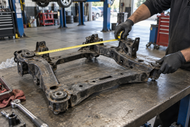
How to Match a Used Crossmember or Subframe
Posted by Parts Depot on Sep 12th 2026
The best way to match a used crossmember is to combine a correct vehicle lookup with part identification and photographs of the mounting arrangement. Neither a VIN by itself nor a broad listing title proves that a used assembly fits. The seller or installer must connect your exact vehicle to the proposed part through a reliable catalog or interchange result.
Step 1: identify the receiving vehicle and the assembly
Collect the year, make, model, body style or chassis code, engine, transmission, drivetrain, and VIN. Add production information if the catalog requests it. Give the seller the installed location: front suspension member, rear subframe, engine cradle, or transmission support.
Have the shop mark the damaged part in a photograph or diagram. This is especially useful when a seller uses “crossmember” for several supports. A VIN helps narrow the application, but the damaged assembly still needs to be identified correctly.
Step 2: separate OEM numbers from inventory markings
| Number type | What it can tell you | What it cannot prove alone |
|---|---|---|
| OEM service part number | A catalog identity that can support an application lookup | The current condition of a used part |
| Casting or stamping number | An identifier useful for further investigation | That it is always the orderable service assembly number |
| Salvage stock number | The seller’s inventory identity | OEM compatibility |
| Interchange reference | A used-parts application grouping when applied correctly | That every attachment on a loaded assembly is suitable |
| Paint-marker notation | Potential donor or yard information | An independently verified fitment match |
Photograph every readable label or stamping rather than rewriting an uncertain digit. Ask the seller which number it used for the compatibility check. Confusing a yard stock number with an OEM number can make a search appear precise while matching nothing useful.
Step 3: resolve different numbers instead of guessing
Different numbers can be valid alternatives when a manufacturer supersedes a part or a reliable interchange record connects the applications. Ask for the explanation: which original number is replaced, what conditions apply, and whether brackets or other pieces must be transferred under the approved application.
The opposite mistake is treating similar numbers as equivalent. A suffix or revision can matter. If the relationship is not established, keep the proposed part as an unconfirmed candidate. Do not grind, drill, slot, or weld structural mounting points to overcome uncertainty.
Step 4: compare the mounting arrangement
- Body or chassis bolt locations, sleeves, and mounting pads.
- Suspension-arm bracket position and attachment details.
- Powertrain or differential mounting provisions where applicable.
- Steering-related attachment locations on the relevant front assembly.
- Removable brackets, heat shields, braces, and line or wiring supports needed for installation.
Pictures are an additional check, not dimensional certification. A collision-bent original can distort the comparison, and a revised service part may look different in a noncritical area. Ask the installer to resolve differences with the catalog and service information before proceeding.
Step 5: check the components on a loaded assembly separately
A compatible main structure does not establish that an attached differential, steering rack, hub, sensor, or arm matches your car. Get the identity and condition of components you intend to use. Specify whether the price is for the frame alone or the attached parts as functioning, warranted items.
For example, buying an AWD rear cradle with a differential attached should trigger a separate differential application check. Do not assume the correct ratio or configuration from the cradle’s fitment. Your shop may prefer to transfer the original serviceable component.
A message you can send with a fitment request
“I need a used [front/rear and exact assembly name] for a [year, make, model], [engine], [transmission], [drivetrain], [body/chassis]. I can provide the VIN privately. The number visible on the old part is [number], and I have attached photographs. Please confirm the application by OEM number, supersession, or documented interchange; list what is included; and send current photos of both faces and all major mounts. Please also confirm delivered price and fitment-return terms.”
Fill the brackets with your vehicle’s actual information. If the original number is unreadable, say so rather than inventing one. The message is a purchase checklist, not a guarantee that a seller’s response is correct.
When the original part number is missing
Use the VIN-based catalog lookup, exact configuration, assembly diagram, and clear photographs together. Ask the installer or seller to identify the service part first. A missing stamping does not make the repair impossible; it means the application lookup becomes more important.
Avoid choosing solely by the lowest price or closest-looking photograph. If the seller cannot establish compatibility, use another candidate. Return freight and a vehicle stuck on a lift can outweigh a small purchase-price saving.
Confirm the replacement again when it arrives
Compare the delivered assembly with the seller’s photographs and the written inclusion list. Photograph shipping damage before installation, inspect the mounting points, and have the shop perform its final comparison before transferring components. Keep the packaging and documentation until any damage or fitment question is resolved.
A correct number does not excuse a cracked bracket or severely corroded member. Fitment and structural condition are independent requirements. Read the rust and damage guide if the metal condition is uncertain.
Find vehicle-specific guidance
Start with the crossmember and subframe guide index or search Parts Depot’s crossmember listings. Check the exact application and current availability before buying. Use the installed-cost guide to compare proposals that include different amounts of hardware and transfer labor.
Browse available crossmembers
Browse Subframes & Crossmembers, or call (561) 231-0439 with your vehicle details to ask about fitment and availability.
Need the part covered in this guide?
Shop used OEM replacement parts from Parts Depot with free U.S. shipping, a 1-year replacement warranty, and help confirming fitment before you order.